Most large online database
systems, including LAS, are based on a "client-server" computing
architecture. This consists of:
A more powerful computer
called a "server" or "host" that provides information and
services to a "client" computer or terminal in response to
requests from that client.
Components of a
client-server system
A
database, a collection
of information that is digitally electronically stored and
organized in a way that facilitates the retrieval of any type or
piece of information. Software called a
"database
management system" (DBMS)
creates and manages access to and use of databases.
Examples:
AltaVista's
database
Sirsi Unicorn's
catalog
OCLC and RLIN bibliographic
databases.
InfoTrac, Ebsco, and
ProQuest article databases.
A "host"
or "file
server" computer, which has
the database (library catalog) stored on it (usually as binary 0s
and 1s on a magnetic hard disk, CD-ROM, floppy disk, or magnetic
tape). The host computer provides the processing power for hosting
and utilizing the database. Specifically, the computer "serves" up
or processes database information when it receives an action
request (typically a "search" or "get" request) from a remote
"client" computer or terminal.
Examples: AltaVista's several
DEC Alpha computers, Sirsi Unicorn's IBM RS6000 server, OCLC's
and RLIN's servers.
A "client"
terminal or computer, which is the local Mac, or PC, or "dumb"
terminal you are using. You use this to issue your search requests
or commands (such as "gets") to the remote server.
A communications
medium (wire, local electronic
circuitry, telephone lines, microwave, infrared, satellite
communications, Internet) that physically implements a network
linking the host computer to a client computer.
The OCLC (Online Computer
Library Center) consortium, for example, has a private network
available to its member libraries.
There are also a variety of
hardware components to a viable network, including
signal-routing devices called routers or bridges, a "firewall"
interface that prevents hacking (unauthorized use or misue of
your system), modems, and more.
Example
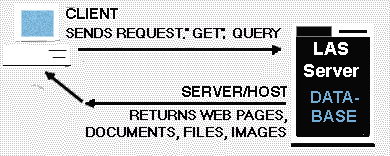
An illustration of the
Client/Server relationship:
A good visual example on the
relationship of the major components of a LAS is on a Web page of
the LAS vendor BestSeller:


 -
optimized for Netscape & 800x600
display
-
optimized for Netscape & 800x600
display